
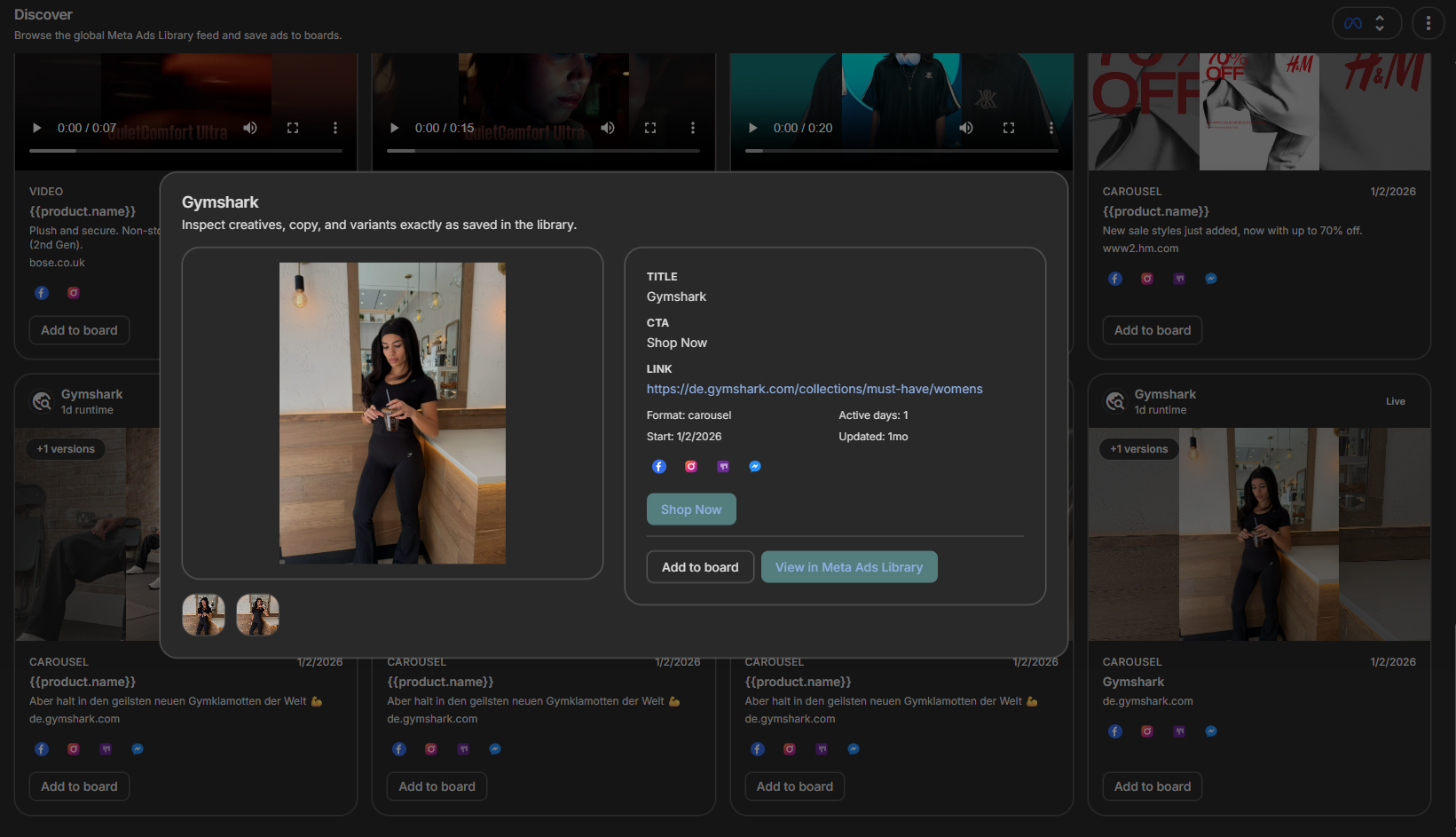
You have the Ad Library bookmarked. You check it before every creative sprint. Maybe you scroll through a competitor's active ads, screenshot a few that catch your eye, and drop them into a Slack channel.
That puts you ahead of most marketers. But it still leaves enormous intelligence on the table.
The teams that consistently win on paid media treat competitor ad research as an ongoing operational discipline, not a sporadic browsing habit. They build systems that surface patterns invisible to casual observers: which hooks survive past week two, which formats a competitor is scaling spend behind, and where the gaps in a category's creative landscape actually are.
This guide breaks down the advanced playbook. If you already know your way around an ad library, this is where you go next.
Why Basic Ad Library Browsing Falls Short
The native Meta Ad Library and Google Ads Transparency Center are powerful starting points. But they were built for transparency compliance, not competitive strategy. That distinction matters.
Here is what you miss when you rely on basic browsing alone:
- No longitudinal view. You see what is running right now, not what ran for six months versus what got killed after three days. Longevity is one of the strongest signals of ad performance, and basic browsing strips it away.
- No cross-platform picture. A competitor's Meta strategy often looks completely different from their Google or TikTok strategy. Browsing one platform at a time fragments your understanding.
- No structural analysis. You can see an ad, but you cannot easily decompose it into its hook, value proposition framing, layout pattern, and CTA structure without deliberate effort.
- No team memory. Screenshots in Slack threads and bookmarks in browser folders decay fast. Three months later, nobody can find that brilliant competitor ad from Q3.
The gap between browsing and intelligence is a system: a repeatable process for collecting, analyzing, and acting on what your competitors are doing in paid media.
Building a Systematic Competitor Monitoring Framework
Ad hoc research gives you snapshots. A monitoring framework gives you a moving picture. Here is how to build one.
The Competitor Intelligence Framework
Follow these concrete steps to move from reactive browsing to proactive intelligence:
- Define your competitive set. Go beyond the obvious direct competitors. Include adjacent brands targeting the same audience, emerging DTC players gaining share, and any brand whose creative your audience is exposed to. Aim for 8-15 brands across tiers (direct, adjacent, aspirational).
- Establish monitoring cadence. Weekly scans for your top five competitors. Bi-weekly for the rest. Monthly deep dives into one competitor at a time, rotating through the full list.
- Standardize your collection. Every saved ad should include the brand name, platform, format, date first seen, and a tag for the campaign theme or funnel stage. Without consistent metadata, you cannot query your own library later.
- Centralize in shared boards. Individual folders and screenshots do not scale. Use shared boards that the entire creative and media team can access, annotate, and reference during briefs. In Glued, this is the boards system -- organized swipe files that any team member can browse and contribute to.
- Capture ads in the wild, not just from libraries. Some of the most valuable competitive intelligence comes from ads you encounter in your own feed. They reveal targeting overlap and give you the consumer's-eye-view of how a competitor's ad actually renders. Glued's Chrome extension lets you save any ad you see while browsing directly into your boards with one click.
- Schedule analysis sessions. Raw collection without analysis is hoarding. Block 30 minutes weekly to review new captures and annotate patterns.
Advanced Filtering and Search Techniques
Power users do not scroll. They query. The difference between a five-minute browse and a five-minute targeted search is the specificity of insight you walk away with.
When using Glued's Discover feature, layer these filters to narrow your search:
- Brand + Format: Isolate a single competitor's video ads to see how their motion creative strategy differs from static.
- Platform + Date range: Compare a competitor's Meta creative from the last 30 days against their Google display ads over the same period.
- Engagement signals + Format: Surface the ad formats that are generating the strongest engagement indicators across your competitive set.
- Keyword in ad copy + Brand: Find every instance where a competitor uses a specific claim, promotion type, or positioning angle.
The goal is not to see everything. It is to ask a precise question and get a precise answer. "What video hooks is Brand X testing this month?" is infinitely more useful than "What's Brand X running?"
Search Patterns That Reveal Strategy
Try these queries during your next research session:
- Search for seasonal or promotional language across multiple competitors simultaneously to see who is leaning into discounting versus brand messaging.
- Filter for ads with the longest run times in your category. These survivors are almost certainly profitable and worth deconstructing.
- Look for format shifts. If a competitor suddenly moves from static carousels to short-form video, that usually signals a strategic bet backed by performance data you do not have.
Reading Between the Lines: What Ad Longevity and Spend Patterns Reveal
The most underrated signal in competitive ad intelligence is time. An ad that has been running for 60+ days is telling you something no dashboard metric can: it is working.
Here is how to read longevity signals:
- Ads running 1-7 days: Testing phase. These may never scale. Do not over-index on them.
- Ads running 2-4 weeks: Survived initial testing. Worth monitoring, but still could be cut.
- Ads running 6+ weeks: Almost certainly a proven performer. Study the hook, the offer, the format, and the landing page structure.
- Ads that reappear after a gap: Seasonal winners or evergreen creative being rotated back in. These are gold -- they have been validated across multiple flight windows.
When you combine longevity data with format and messaging analysis, you start to see a competitor's actual media strategy, not just their creative output. You can infer which funnels are getting budget, which audiences they are prioritizing, and where they are experimenting versus doubling down.

Analyzing Creative Patterns Across Competitors
Individual ads are data points. Patterns across ads are insights. This is where most competitive analysis stalls, because pattern recognition across dozens or hundreds of ads is cognitively expensive.
Here are the dimensions to analyze systematically:
Hook Patterns
- What is the opening frame or first line of copy?
- Are competitors leading with pain points, aspirational outcomes, social proof, or curiosity gaps?
- How long are video hooks before the value proposition appears?
Layout and Visual Structure
- Are competitors favoring UGC-style creative, polished studio work, or graphic-heavy designs?
- What text overlay patterns repeat? (Problem/solution split screens, listicle formats, testimonial cards.)
- How are CTAs visually treated -- embedded in the creative or left to the platform's native button?
Positioning and Messaging
- What claims appear most frequently across a competitor's ad set?
- How do they frame their differentiator -- price, quality, speed, exclusivity?
- Are they shifting messaging over time, and if so, in what direction?
This is where AI-powered analysis becomes a genuine force multiplier. Manually categorizing hooks, layouts, and positioning across 50 competitor ads takes hours. Glued's AI analysis breaks down these dimensions automatically, surfacing the structural patterns that would otherwise require a spreadsheet and a very patient strategist.
Turning Intelligence Into Action: Generating Variations
Competitive intelligence that lives in a swipe file but never reaches a creative brief is wasted effort. The bridge between research and output is the hardest part of the workflow, and it is where most teams lose momentum.
Here is a practical workflow for turning intelligence into new creative:
- Identify the winning pattern. From your analysis, isolate the hook structure, format, or positioning angle that appears strongest across your competitive set.
- Define your differentiation. You are not copying. You are identifying what resonates with a shared audience and then executing it through your brand's unique lens.
- Generate on-brand variations. Use the pattern as a structural template and adapt it with your brand voice, value proposition, and visual identity. Glued's AI can take a competitor ad you have saved to a board and generate creative variations that maintain your brand guidelines while leveraging the structural pattern that is working in market.
- Brief with context. When you hand a creative brief to your design team, include the competitor examples from your boards alongside the AI-generated variations. This gives designers both the strategic rationale and a concrete starting point.
- Test and feed back. Run the new creative, measure performance, and feed the results back into your intelligence system. The cycle is continuous.

Building a Team-Wide Competitive Intelligence Culture
The biggest leverage in competitive intelligence is not a tool or a technique. It is making the entire team participants in the system.
For Performance Marketers
Make it standard practice to review the competitive swipe file before building any new campaign. Use boards organized by funnel stage so media buyers can quickly reference what competitors are running for prospecting versus retargeting.
For Creative Strategists
Use the AI analysis outputs as inputs to creative briefs. Instead of vague direction like "make it feel premium," reference specific structural patterns: "Lead with a 3-second problem hook in the style of these top-performing competitor ads, then transition to product demo."
For Leadership
Include a competitive creative landscape slide in monthly performance reviews. Patterns in competitor behavior are leading indicators -- when three competitors simultaneously shift to discount-heavy messaging, the market is telling you something about demand conditions.
Making It Stick
- Add a "competitive capture" item to your weekly team standup. Ask: "Did anyone see a competitor ad worth saving this week?"
- Rotate the monthly deep-dive analysis across team members so everyone builds the analytical muscle.
- Keep boards organized and pruned. A swipe file with 500 unsorted ads is as useless as no swipe file at all.
The Intelligence Advantage Compounds
The teams that win in paid media over sustained periods are rarely the ones with the biggest budgets. They are the ones with the best feedback loops: market observation flowing into creative development flowing into performance data flowing back into sharper observation.
Competitor ad intelligence is the first link in that chain. Treat it as infrastructure, not a one-time project, and the compound advantage becomes difficult for rivals to close.
Ready to build a real competitive intelligence system? Glued gives your team Discover search across ad libraries, shared boards for organized swipe files, AI-powered creative analysis, and a Chrome extension that captures any ad in the wild. Start turning competitor research into a strategic advantage.