
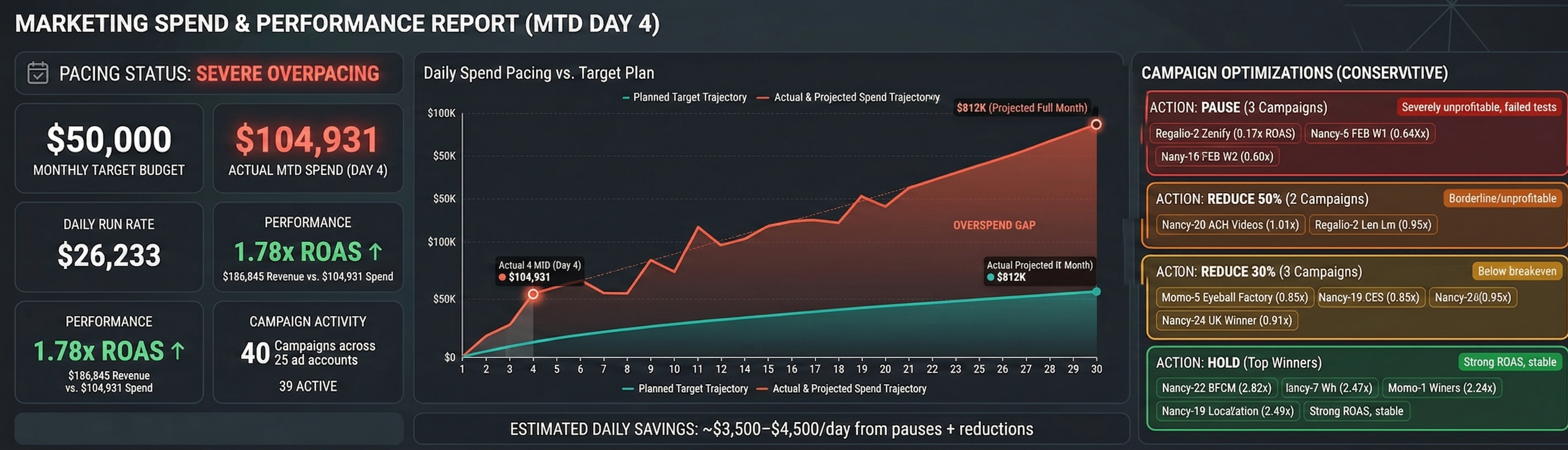
There is a specific kind of panic that every media buyer knows. It is the fifteenth of the month. You open your ad account expecting half your budget spent. Instead, you have burned through 80 percent --- and the campaigns responsible are not even your best performers.
Pause campaigns. Slash budgets. Send an awkward Slack message to the client. This is not a failure of talent. It is a failure of systems.
Why Ad Budgets Spiral
Most overspending happens slowly, in increments that look harmless but compound into serious problems.
Campaign-level budgets do not add up to account-level targets. You set daily budgets across 15 campaigns that technically add up to $1,667 per day. But Meta allows campaigns to overspend daily caps by 20-25 percent. By mid-month, your actual run rate is $2,400 per day.
Nobody is doing the math daily. The dashboard shows yesterday's spend, not yesterday's spend in the context of where you should be on day 14 of a 30-day cycle. That context --- the pacing trajectory --- is what separates a controlled account from one quietly hemorrhaging.
High-performing campaigns mask the problem. When your top campaign prints money at 4x ROAS, nobody questions its spend. But if it consumes 60 percent of your budget, every other campaign starves.
What Budget Pacing Actually Means
Budget pacing is the relationship between three numbers:
- Actual spend to date --- what you have spent so far.
- Expected spend to date --- what you should have spent if spending were evenly distributed.
- Remaining budget vs. remaining days --- what your daily budget needs to be for the rest of the month.
The sweet spot is within 5 percent of your expected trajectory. Anything outside that window needs attention. Overpacing means you run out of budget before month-end. Underpacing means you are leaving opportunity on the table.
The Real-World Math
Say you manage a $50,000 monthly budget. It is March 14th --- you should have spent roughly $22,580. Instead, your dashboard shows $34,000. You are overpacing by 51 percent.
Break it down by campaign:
| Campaign | MTD Spend | ROAS | Status | |---|---|---|---| | Prospecting - Broad | $12,400 | 2.1x | Overconsuming | | Retargeting - Cart | $8,200 | 3.8x | Strong performer | | Prospecting - Lookalike | $6,100 | 0.9x | Underperforming | | Brand Awareness | $4,300 | 0.4x | Cash burn | | New Creative Test | $3,000 | 1.2x | Inconclusive |
The fix is a reallocation table: reduce Brand Awareness and Lookalike Prospecting, hold Broad Prospecting, increase Retargeting. This analysis takes 15 minutes if you have the data --- but pulling the data manually takes an hour per account.
Building a Pacing System
A pacing system has three components:
1. Daily spend check against trajectory. Every morning, you need the gap between actual and expected spend --- not yesterday's spend in isolation. If you manage multiple accounts, this must be automated.
2. Campaign-level efficiency ranking. Sort campaigns by ROAS, then overlay spend share. The highest-efficiency campaigns should get proportional budget. If your best campaign has 3x the ROAS of your worst but only 20 percent of the spend, something is misallocated.
3. Reallocation rules (written down, not improvised). Define rules in advance. Conservative mode: reduce underperformers first, pause only below 0.5x ROAS with 7+ days of data. Aggressive mode: pause all below breakeven, consolidate into top three. When overpacing hits, execute the playbook instead of panicking.
What This Looks Like With Glued MCP
Using Glued's MCP API paired with AI agent skills, this entire pacing workflow runs automatically. Here is an actual pacing analysis generated from a live ad account --- the system pulled dashboard data, computed trajectory gaps, ranked campaigns by efficiency, and generated a complete reallocation plan with rule logic:
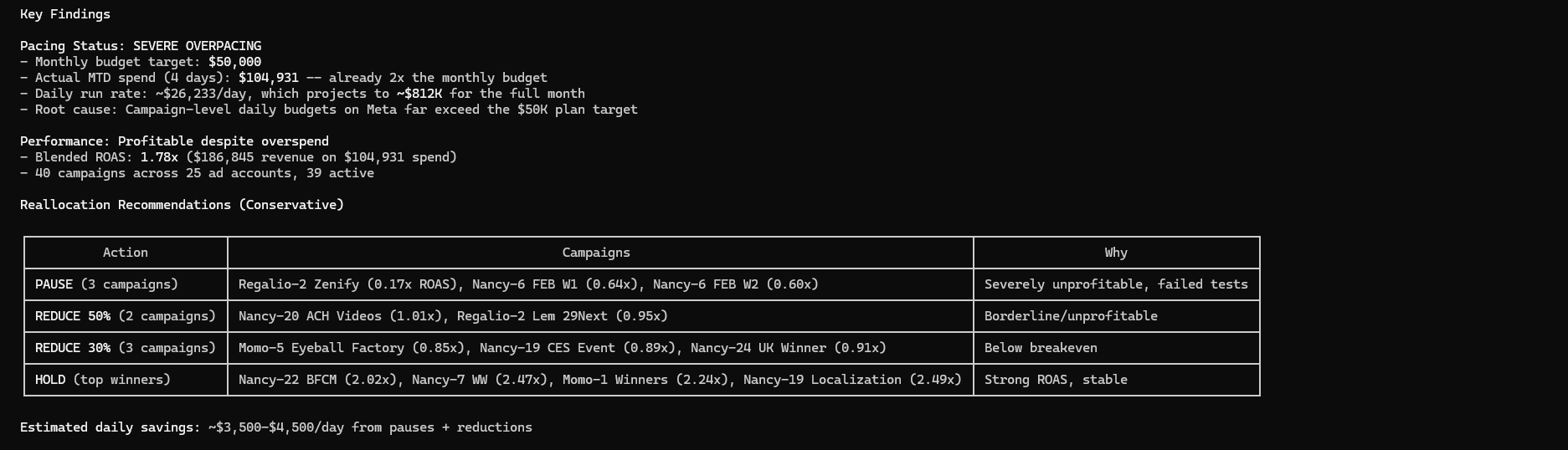
In this example, the system detected severe overpacing at 1,526% over a $50K monthly target across multiple campaigns. It identified 3 campaigns to pause, 5 to reduce, and generated two budget alignment options --- all before the morning standup.
Common Pacing Mistakes
Checking pacing weekly instead of daily. By day 7, you have consumed too much to recover gracefully.
Pacing at the account level only. Account-level pacing can look fine while individual campaigns are wildly over or under.
Ignoring conversion lag. Same-day ROAS looks terrible for campaigns with a 3-7 day conversion window. Check 7-day lookback before cutting.
Resetting budgets too aggressively. Slashing a campaign's budget by 50 percent resets its learning phase. Make changes in 20 percent increments.
The Pacing Checklist
Run this every morning:
- [ ] Gap between actual and expected spend?
- [ ] Campaigns above 110% of expected trajectory?
- [ ] Campaigns below 90% of expected trajectory?
- [ ] Highest-ROAS campaigns getting proportional budget?
- [ ] Any campaigns spending heavily below breakeven?
- [ ] Recommended daily budget for remaining days realistic?
If you cannot answer these in under five minutes per account, your data infrastructure needs work. The agencies and media buyers who manage money well are not smarter. They just have better systems.
Ready to automate your budget pacing? Glued's MCP API connects your Meta and Google Ads accounts to AI-powered workflows that compute pacing trajectories, flag anomalies, and generate reallocation recommendations --- automatically, every morning, for every workspace. Start your free trial at glued.me and stop finding out about budget problems after it is too late.