
Every day, your customers are telling you exactly why they will not buy. They are telling you what confuses them, what excites them, what scares them off, and what your competitors are doing better. They are doing this for free, unprompted, in plain language.
And you are probably ignoring all of it.
The data is sitting right there in your ad comments. Facebook ad comments, Instagram ad comments, YouTube ad comments. Thousands of unfiltered, brutally honest reactions from the exact people you are paying to reach.
Most performance marketers treat ad comments as a moderation chore. Hide the spam, delete the profanity, maybe respond to the occasional customer question. That is like finding a vein of gold in your backyard and using it as a doorstop.
Ad comment sentiment analysis is one of the most underrated tactics in performance marketing. When done right, it creates a direct feedback loop between your audience and your creative strategy, and it can meaningfully lower your customer acquisition cost.
Here is how.
Why Ad Comments Are the Most Undervalued Data Source in Paid Media
Think about the data you obsess over daily. CTR. ROAS. CPA. Thumbstop rate. Hook rate. These are all behavioral signals. They tell you what people did, but they almost never tell you why.
Ad comments are the why.
When someone stops scrolling, reads your ad, and takes the time to type a comment, they are giving you something no click or impression metric can provide: context. They are expressing intent, voicing objections, asking questions, and revealing the exact friction points in your funnel.
Here is what makes comments especially powerful:
- They come from your target audience. These are people your targeting selected. Their feedback is more relevant than any survey panel.
- They are unsolicited. Nobody prompted these responses. They reflect genuine, unfiltered reactions.
- They are public. Other potential buyers read them. Negative comments can tank conversion rates. Positive ones can accelerate them.
- They are real-time. Comments appear within hours of a creative going live, far faster than waiting for statistically significant performance data.
Despite all this, most brands have zero systems in place to capture and analyze comment data at scale. That is a massive missed opportunity.
What Ad Comment Sentiment Analysis Actually Is
Ad comment sentiment analysis is the process of systematically categorizing and interpreting the comments on your paid social ads to extract actionable insights.
At its simplest, it means reading every comment on your ads and tagging them as positive, negative, or neutral. But the real value comes from going deeper than raw sentiment.
A proper comment analysis workflow classifies comments by type: Is this an objection? A product question? A competitor mention? A purchase intent signal? Social proof? A complaint about the ad itself?
When you layer type classification on top of sentiment, you stop seeing comments as noise and start seeing them as a structured dataset. One that tells you exactly where your messaging, your product positioning, or your landing page is falling short.
Doing this manually on a handful of ads is straightforward enough. Doing it across fifty active creatives, seven days a week, across multiple ad accounts? That requires automation.
The Five Types of Insights Hiding in Your Ad Comments
Not all comments are created equal. Here are the five categories that matter most for lowering CAC, along with what to do when you spot each one.
1. Objections and Hesitations
These are the comments that reveal why people are not converting. They are the most valuable comments you will ever read.
Examples:
- "Looks cool but $79 is way too much for this."
- "How is this different from [Competitor]?"
- "Does this actually work or is it another dropship scam?"
- "I would buy this but I do not trust the return policy."
Action: Feed these objections directly to your creative team. Every objection is a brief for a new ad angle. Price objection? Test a value-justification ad. Trust objection? Test a UGC testimonial ad or a money-back guarantee callout. Competitor comparison? Build a versus-style creative.
2. Product Questions
When people ask specific questions about your product in the comments, it means your ad or landing page failed to communicate something important.
Examples:
- "What sizes does this come in?"
- "Is this compatible with iPhone 16?"
- "How long does shipping take?"
Action: Update your ad copy, landing page, and FAQ to answer these questions before they are asked. Every unanswered question is a potential lost conversion.
3. Competitor Mentions
Your audience will straight up tell you who they are comparing you against. This is free competitive intelligence.
Examples:
- "I use [Competitor] and it does the same thing."
- "This is just a more expensive [Competitor]."
- "I switched from [Competitor] and this is way better."
Action: Map competitor mentions to understand your positioning gaps. Build differentiation-focused creatives. Consider running targeted campaigns against competitor audiences with messaging that addresses the exact comparison points people raise.
4. Social Proof and Advocacy
Positive comments from happy customers are marketing assets. They are more persuasive than anything your copywriter can produce because they come from real people.
Examples:
- "Bought this last month and it is incredible."
- "This literally changed my morning routine."
- "Already ordered my second one."
Action: Screenshot these and use them in future ad creative (with permission, if needed). Pin the best ones. Consider reaching out to enthusiastic commenters about UGC partnerships. Make sure positive comments are visible, not buried beneath negative ones.
5. Purchase Intent Signals
Some comments are buying signals in disguise. These people are at the bottom of the funnel and just need a nudge.
Examples:
- "Adding this to my wishlist."
- "Payday cannot come soon enough."
- "Does anyone have a discount code?"
Action: Respond quickly with links, discount codes, or urgency messaging. Build retargeting audiences from people who engaged with your ads. These are warm leads actively looking for a reason to convert.

How to Set Up a Comment Monitoring Workflow
If you are convinced that ad comments matter (and you should be), the next step is building a system that captures this intelligence consistently. Here is a practical workflow.
Step 1: Centralize Your Comment Data
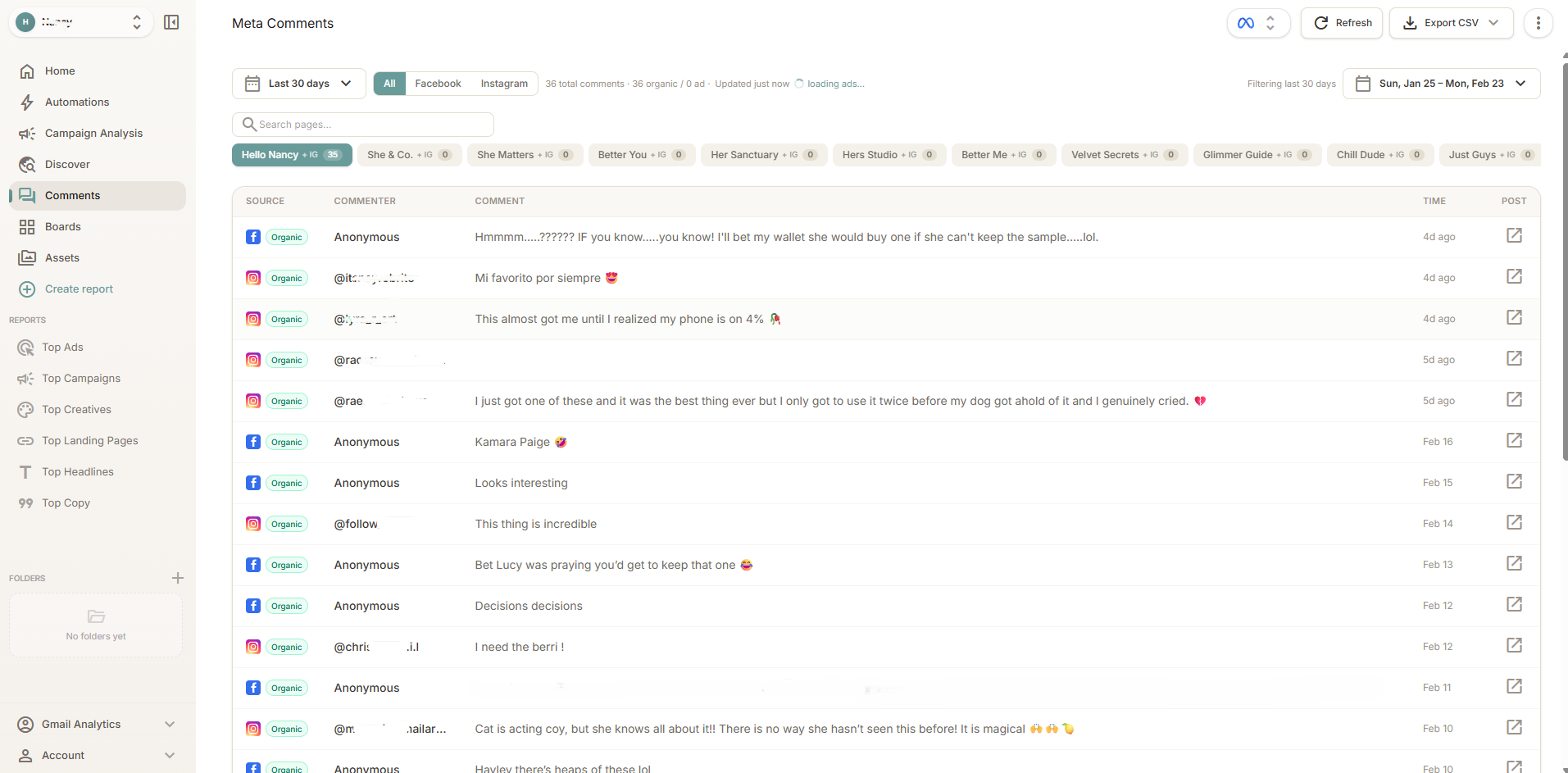
Stop checking comments natively in each ad platform. You need a single place where all ad comments across all creatives are collected and visible. Export them, pull them via API, or use a tool that aggregates them automatically.
Step 2: Classify by Sentiment and Type
Every comment should be tagged along two dimensions:
- Sentiment: Positive, Negative, Neutral
- Type: Objection, Product Question, Competitor Mention, Social Proof, Purchase Intent, Spam/Irrelevant
This can be done manually for low-volume accounts, but it gets unsustainable fast when you are running dozens of active creatives.
Step 3: Route Insights to the Right People
Comment data is useless if it stays in a dashboard nobody checks. You need to push the insights to where decisions happen:
- Creative team gets a weekly summary of top objections and questions.
- Landing page owner gets flagged product questions and confusion signals.
- Community manager gets purchase intent signals for immediate response.
- Media buyer gets sentiment trends by creative to spot fatigue or negative reactions early.
Step 4: Create a Feedback Loop
The most important step. Set up a recurring cadence, weekly at minimum, where comment insights feed directly into your creative sprint. Every batch of new ads should address at least one objection or question surfaced from the previous batch's comments.
This is how you build a compounding advantage. Each creative cycle gets sharper because it is informed by real audience feedback, not guesswork.
Turning Comment Insights Into Lower CAC
Let us get specific about how this workflow actually reduces your customer acquisition cost.
Creative Iteration That Hits Harder
When your ad concepts are built on real objections and real questions from your audience, they convert better. Period. You stop wasting budget testing creative angles based on gut feel and start testing angles that address verified friction points.
A brand that discovers "people think our product is too expensive" can test five different value-framing angles in their next sprint. That is infinitely more productive than testing five random hooks.
Landing Page Fixes That Remove Friction
If twenty people in your ad comments are asking the same product question, your landing page has a gap. Fix it and your conversion rate improves. Better conversion rate means lower CAC at the same spend level.
Common landing page fixes surfaced by comments:
- Adding sizing charts or compatibility info
- Addressing shipping time and return policy concerns
- Including social proof and real customer quotes
- Clarifying pricing or subscription terms
FAQ and Support Improvements
Recurring questions in ad comments often mirror the questions your support team fields after purchase. Addressing them proactively, in your ads, on your landing page, and in your FAQ, reduces pre-purchase friction and post-purchase support costs simultaneously.
Smarter Audience Targeting
Competitor mentions tell you which brands your audience is cross-shopping. This is direct input for your targeting strategy and your competitive positioning. If 30% of your comments mention a specific competitor, you know exactly who to differentiate against.
Automating Comment Analysis at Scale
Here is the reality: doing this manually does not scale.
If you are running ten creatives, you can probably read through comments every morning with your coffee. If you are running fifty or a hundred, you need automation.
This is exactly the problem that Glued's Comment Sentiment Digest was built to solve. It uses AI to automatically scan ad comments across your active creatives, classify them by sentiment and type, and deliver a structured summary directly to your team's Slack channel on a schedule you define.
Instead of hiring someone to read hundreds of comments daily, you get an automated digest that surfaces the insights that matter: new objections trending across your ads, product questions that keep recurring, competitor names that keep appearing, and purchase intent signals your community manager should respond to.
Glued's Comments Intelligence feature takes this further by letting you analyze and export comment data in bulk. You can filter by sentiment, search for specific themes, and pull structured datasets that feed directly into your creative planning sessions.
The combination means your team gets a continuous, automated feedback loop between your audience's reactions and your creative output. No manual scraping. No spreadsheet wrangling. No insights falling through the cracks.

Real-World Examples of Comment-Driven Optimizations
To make this concrete, here are three scenarios where comment sentiment analysis directly impacted CAC.
Scenario 1: The Price Objection That Sparked a Winner
A DTC skincare brand noticed that across multiple ad creatives, comments consistently mentioned price as a barrier. Instead of lowering prices, the creative team built a new ad angle breaking down the cost-per-use compared to drugstore alternatives. That single creative became their top performer for the quarter, lowering overall CAC by 18%.
Scenario 2: The Shipping Question Nobody Answered
An electronics brand kept seeing "how long does shipping take?" in their ad comments. Their landing page did not mention shipping timelines at all. After adding a prominent "Free 2-Day Shipping" badge to both ads and the product page, their add-to-cart rate jumped 12%.
Scenario 3: The Competitor Comparison That Wrote Its Own Ad
A fitness supplement brand discovered through comment analysis that a significant portion of their audience was comparing them to a well-known competitor. They built a comparison-style ad that directly addressed the differences. It outperformed their standard creative by 2.4x on ROAS.
None of these insights came from A/B testing tools, attribution platforms, or creative analytics dashboards. They came from reading what real people were saying in the comments.
Start Treating Comments as a Strategic Asset
The gap between brands that use comment data and brands that ignore it is only going to widen. As ad platforms become more algorithmic and targeting options continue to converge, the brands that listen to their audience most closely will build creative that converts most efficiently.
You do not need a complicated setup to get started. Begin by reading through the comments on your top five active ads this week. Categorize what you find. Look for patterns. Bring those patterns to your next creative meeting.
And when you are ready to automate the process, take a look at Glued's Comment Sentiment Digest and Comments Intelligence features. They are purpose-built to turn the signal buried in your ad comments into a structured, automated workflow that makes your entire creative engine smarter.
Your customers are already telling you how to lower your CAC. It is time to start listening.